
New York permit test
practice questions
Study for the New York driver's license knowledge test with questions written from the Driver's Manual and New York traffic law. Try the sample questions below, then get all 901 in the app.
 NY
About the New York test
Question count and passing score follow the DMV official information. Official handbook: Driver's Manual ↗
Try 10 sample questions
Each one covers the same point as a practice question the DMV has published. Tap an answer to see if you are right and why.
A green left arrow is lit at the same time as a red light. You may:
A green arrow shown with a red light allows only the movement the arrow points to, from the proper lane. You still yield to vehicles and people already in the intersection; the red light still applies to going straight.
You are approaching an intersection when the green light changes to steady yellow. You should:
Steady yellow warns you that red comes next, so be ready to stop. Speeding up to beat the red light and braking suddenly are both dangerous.
According to the New York manual, being in good physical shape:
BAC rises with the amount of alcohol, with drinks taken close together and with a lower body weight. The kind of drink, physical fitness and a belief that you can "hold your liquor" make no difference.
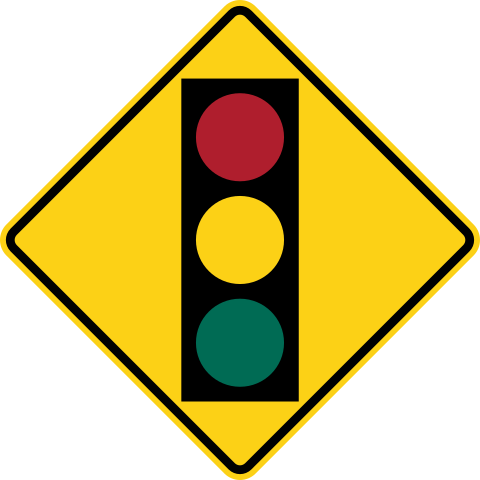
This sign alerts you to:
This sign warns you of a traffic signal ahead, often beyond a curve or hill where it is hard to see. Slow down and be ready to stop if it is red.
A driver's left arm is bent at the elbow with the hand pointing up. This signals:
Pointing the left hand upward is the right-turn signal. Pointing it downward means slow or stop, and a straight-out arm means a left turn.
Going around or under a crossing gate while it is being lowered is:
You must stop for a lowering or lowered gate and stay stopped until it rises. A clear view down the tracks does not make going around the gate legal.
When you see a sign warning that your lane ahead is closed, you should:
When a sign warns that your lane closes ahead, adjust your speed and watch the guide signs and the traffic around you. Merge into the open lane once there is a safe gap; racing to the end of the lane often forces a late, risky merge.
Where must a New York bicyclist normally ride when there is no bicycle lane?
Bicyclists must use a bike lane where there is one; otherwise they stay near the right curb or edge or on a right shoulder, except when preparing to turn left or avoiding hazards. Bicyclists may not ride more than two abreast in one lane, and they must stop fully before entering a road from a driveway or alley.
Temporary signs in work zones usually have:
Orange is the color for construction and maintenance warnings, with black letters or symbols. Black on yellow is used for general warning signs outside work zones.
When another vehicle is passing you on the left, you should:
The New York manual says that when another vehicle overtakes you on the left, slow down a little and keep to the center of your lane; once it is safely ahead, resume your normal speed. Never speed up while being passed.
The app has 901 more questions for New York, with explanations for every one.
Other states
Ready for the New York test?
No account, no ads. Five guides take you from the basics to a full-length practice exam.